---
title: Borrowing & Loops
description: >-
Learn how SV3 advances let holders pledge tokens for USDC without selling,
plus how repayment, surrender, and looping mechanics affect collateral and
debt.
---
> **For AI agents:** the complete documentation index is at [llms.txt](/llms.txt). Append `.md` to any page URL for its markdown version.
An SV3 advance lets a holder turn part of a token's floor value into USDC without selling through the curve. The holder pledges tokens, the market sends USDC, and enough collateral stays locked to cover the gross debt at the current floor.
## A simple position
Suppose you pledge **10,000 tokens** when the floor is **$0.01**.
```text
total gross capacity = 10,000 × $0.01 = $100
```
You choose to draw $40:
| Position after the advance | Amount |
| -------------------------- | -----: |
| Gross debt | $40.00 |
| One-time 3% fee | $1.20 |
| USDC sent to your wallet | $38.80 |
| Tokens locked by debt | 4,000 |
| Free pledged tokens | 6,000 |
| Interest rate | 0% |
| Due date | None |
The debt balance is $40 because the origination fee is withheld from the payout.
## What happens to the market reserve
Opening the $40 advance changes the market's balance sheet:
```text
liquid reserve decreases by $40
outstanding debt increases by $40
gross backing is unchanged before fee effects
spot, floor, supply are unchanged
```
Gross backing counts liquid reserve plus outstanding debt. The pledged tokens stay in market custody and remain part of floor liability, so the same value cannot also be withdrawn or sold.
## Your three exit choices
### Repay
Send USDC back to reduce debt. The matching collateral becomes free immediately. Partial repayment is allowed and has no protocol repayment fee.
### Keep the position open
Debt does not accrue interest and has no maturity date. You may leave it open while the tokens remain pledged.
### Surrender collateral
Ask the market to burn enough pledged tokens to cancel debt. At a 0.01 USDC floor, surrendering 40 USDC of debt burns 4,000 tokens. No USDC moves and no surrender fee is charged.
Surrender is irreversible. It is the on-chain non-recourse close: the contract's claim ends with the collateral burned for the selected debt amount.
## A higher floor frees collateral
If the floor later rises from 0.01 to 0.02 USDC while debt stays at 40 USDC:
| Position value | Before | After |
| -------------------------- | -----: | ----: |
| Floor | $0.01 | $0.02 |
| Tokens needed to cover $40 | 4,000 | 2,000 |
| Free pledged tokens | 6,000 | 8,000 |
The debt remains fixed while the higher floor reduces the number of tokens required to secure it.
## Position formulas
Let $n$ be pledged token quantity, $F$ the current floor, $K$ total floor capacity, $D$ gross debt, $n_L$ locked collateral, and $n_f$ free collateral.
$$
K=nF
$$
$$
n_L=\lceil D/F\rceil
$$
$$
n_f=n-n_L
$$
Borrow capacity rounds down. Collateral required for debt and surrender rounds up.
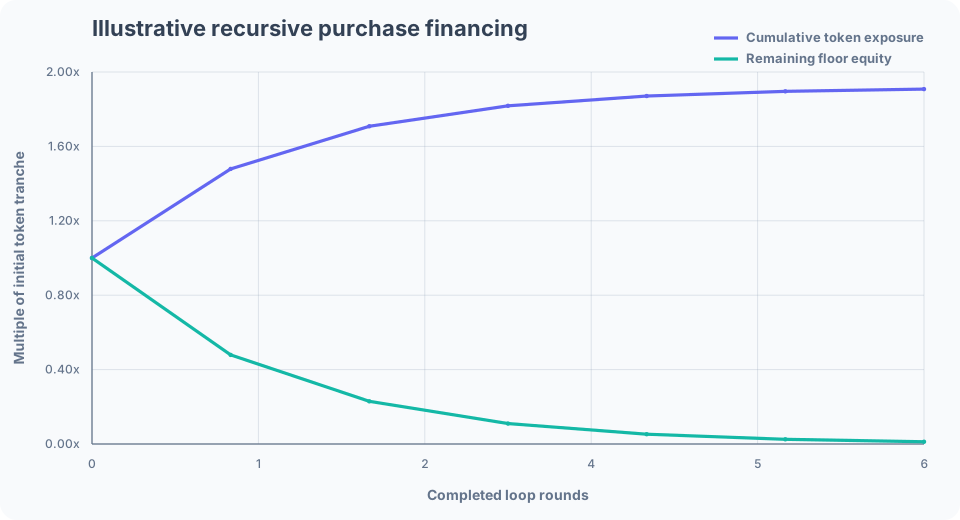
## Looping: borrow, buy more, repeat
A loop spends advance proceeds on another curve buy, then pledges the new tokens:
```mermaid
flowchart LR
A[Buy tokens] --> B[Pledge tokens]
B --> C[Draw floor value]
C --> D[Receive proceeds after 3% fee]
D --> E[Buy more tokens after 1.25% fee]
E --> B
```
The next token tranche is smaller because:
- floor is below the average purchase price;
- the advance fee removes 3%;
- the next buy removes 1.25%; and
- the rising curve makes each later purchase more expensive.
For tranche $q$ and average price $\bar P$ on the next buy:
$$
q'=q(F/\bar P)(1-0.03)(1-0.0125)
$$
Holding $F/\bar P$ constant gives an upper bound:
| Floor / average next buy | Next tranche | Exposure limit |
| -----------------------: | --------------------: | -------------------: |
| 0.25 | 0.2395× prior tranche | 1.32× initial tokens |
| 0.50 | 0.4789× prior tranche | 1.92× initial tokens |
| 0.75 | 0.7184× prior tranche | 3.55× initial tokens |
| 1.00 | 0.9579× prior tranche | 23.74× theoretical |
 ## The risk in a looped position
Looping converts floor equity into debt. When spot falls toward floor, the premium that supported the position disappears while gross debt stays fixed. A deeply looped position can finish with almost no floor equity even though the protocol never runs a liquidation auction.
A complete preview should show:
- total pledged tokens;
- gross debt and net cash received;
- locked and free collateral;
- spot equity: `collateral × spot - debt`;
- floor equity: `collateral × floor - debt`;
- fees paid; and
- the executable unwind quote after curve impact.
See [Fees](/protocol/fees) for the action-fee split and [Risks & Controls](/trust/risks-and-controls) for pause, reserve, and contract boundaries.
## The risk in a looped position
Looping converts floor equity into debt. When spot falls toward floor, the premium that supported the position disappears while gross debt stays fixed. A deeply looped position can finish with almost no floor equity even though the protocol never runs a liquidation auction.
A complete preview should show:
- total pledged tokens;
- gross debt and net cash received;
- locked and free collateral;
- spot equity: `collateral × spot - debt`;
- floor equity: `collateral × floor - debt`;
- fees paid; and
- the executable unwind quote after curve impact.
See [Fees](/protocol/fees) for the action-fee split and [Risks & Controls](/trust/risks-and-controls) for pause, reserve, and contract boundaries.