---
title: Curve & Floor Math
description: >-
This page defines the fixed-point math behind SV3 curve pricing, floor raises,
and area preservation used in the $10 launch simulation.
---
> **For AI agents:** the complete documentation index is at [llms.txt](/llms.txt). Append `.md` to any page URL for its markdown version.
This page defines the math behind the behavior shown in the [$10 launch simulation](/simulations/ten-dollar-launch). Prices use 18-decimal fixed point. Token quantities use 18 decimals, while reserve balances settle in 6-decimal USDC atoms.
## Curve shape
An SV3 curve has three connected regions:
1. a flat floor;
2. a steeper ramp; and
3. the main rising line.
Let $x$ be curve supply, $F$ the floor, $x_1$ the end of the flat region, $x_2$ the end of the ramp, $m_1$ the ramp slope, and $m_2$ the main slope.
For the flat region through $x_1$:
$$
P(x)=F
$$
For the steeper ramp from $x_1$ through $x_2$:
$$
P(x)=F+m_1(x-x_1)
$$
For the main line above $x_2$:
$$
P(x)=F+m_1(x_2-x_1)+m_2(x-x_2)
$$
The v1 preset fixes the ramp at 2.5 times the main slope:
$$
m_1=2.5m_2
$$
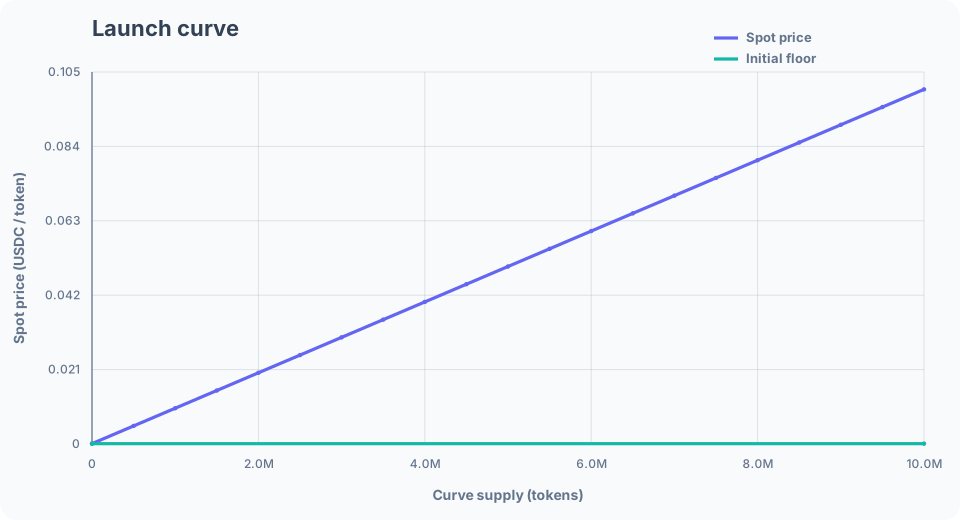
At launch, $x_1=x_2=0$. The curve therefore begins as one rising line from the initial floor.
| V1 linear curve field | Human value |
| ---------------------------- | ------------------------------------------: |
| Initial floor $F_0$ | 0.0001 USDC/token |
| Main slope $m_2$ | 0.00000001 USDC per additional whole token |
| Ramp slope $m_1$ | 0.000000025 USDC per additional whole token |
| Ramp end and width at launch | 0 |
 ## Reserve is the area under the curve
Define curve area through supply $x$:
$$
A(x)=\int_0^x P(s)\,ds
$$
A buy that moves supply from $C_0$ to $C_1$ deposits:
$$
R_b=A(C_1)-A(C_0)
$$
A sell moving from $C_0$ down to $C_1$ receives this gross curve output before fees:
$$
R_s=A(C_0)-A(C_1)
$$
At launch:
$$
P(x)=F_0+m_2x
$$
$$
A(x)=F_0x+0.5m_2x^2
$$
This gives the buy-only relationship used in the simulation:
$$
P^2=F_0^2+2m_2R
$$
The market can mint only after receiving the corresponding area. A curve sell burns the returned tokens and releases the area that is no longer required.
## How a floor raise restructures the selloff
An area-preserving raise changes the lower shape of the curve while holding both live spot and required curve area fixed at current supply $C$:
$$
A_1(C)=A_0(C)
$$
$$
P_1(C)=P_0(C)
$$
## Reserve is the area under the curve
Define curve area through supply $x$:
$$
A(x)=\int_0^x P(s)\,ds
$$
A buy that moves supply from $C_0$ to $C_1$ deposits:
$$
R_b=A(C_1)-A(C_0)
$$
A sell moving from $C_0$ down to $C_1$ receives this gross curve output before fees:
$$
R_s=A(C_0)-A(C_1)
$$
At launch:
$$
P(x)=F_0+m_2x
$$
$$
A(x)=F_0x+0.5m_2x^2
$$
This gives the buy-only relationship used in the simulation:
$$
P^2=F_0^2+2m_2R
$$
The market can mint only after receiving the corresponding area. A curve sell burns the returned tokens and releases the area that is no longer required.
## How a floor raise restructures the selloff
An area-preserving raise changes the lower shape of the curve while holding both live spot and required curve area fixed at current supply $C$:
$$
A_1(C)=A_0(C)
$$
$$
P_1(C)=P_0(C)
$$
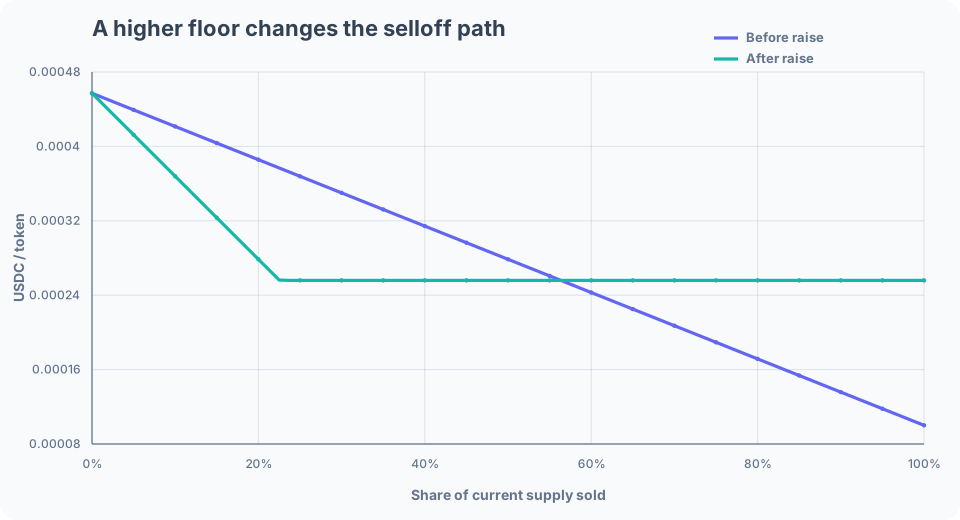 Area preservation concentrates the below-spot price movement into a shorter, steeper ramp. Sellers can therefore move spot faster after the raise. The benefit appears at the end of that ramp: canonical spot reaches a higher floor and stays flat there.
The total curve area is unchanged for this part of the raise. Floor-directed fees or donations can add backing for a further increase.
The deterministic controller applies floor capacity in this order:
1. Use all legal area-preserving headroom.
2. Measure recognized backing surplus.
3. Retain the configured surplus buffer—10% under the default v1 policy.
4. Commit the spendable surplus to the highest additional floor that preserves spot and solvency.
The floor cannot rise above live spot. Under repeated maximum area-preserving raises, the fixed 2.5× ramp approaches a floor/spot ratio near 43.6% as the initial floor becomes small relative to spot. This is curve geometry, not an ATH peg or a guaranteed ratio for every market state.
## Actual supply and curve supply
Most buys and sells move token supply and the curve coordinate together. Some floor-priced actions move only actual supply. SV3 tracks both quantities so every token stays floor-liable without forcing those actions to move spot.
Let:
- $T$ be actual ERC-20 supply;
- $O$ be the signed supply offset; and
- $C$ be virtual curve supply.
$$
C=T-O
$$
| Action | Actual supply $T$ | Curve supply $C$ | Offset $O$ | Spot |
| ------------------------------------ | ----------------: | ----------------: | ---------: | --------: |
| Curve buy | Increases | Increases equally | Unchanged | Rises |
| Curve sell | Decreases | Decreases equally | Unchanged | Falls |
| Floor redemption | Decreases | Unchanged | Decreases | Unchanged |
| Collateral surrender | Decreases | Unchanged | Decreases | Unchanged |
| Future current-floor option exercise | Increases | Unchanged | Increases | Unchanged |
## Backing equations
Let $L_f$ be floor liability, $E_c$ excess curve area above the floor, $R_r$ required backing, $L$ liquid accounted reserve, $D$ outstanding debt, and $B_g$ gross backing.
Before contract rounding:
$$
L_f=FT
$$
$$
E_c=A(C)-FC
$$
$$
R_r=L_f+E_c
$$
$$
B_g=L+D
$$
Every accepted financial action must preserve:
$$
B_g\ge R_r\ge L_f
$$
Outstanding debt remains in gross backing because it records reserve paid early against floor-valued collateral held by the market. The debt is paired with tokens that cannot also be sold or withdrawn.
## Gross floor and wallet proceeds
The on-chain floor $F$ is a gross USDC value per token. Direct floor redemption charges the 1.25% sell fee:
$$
F_n=F(1-0.0125)
$$
Gas and conservative rounding can reduce final wallet proceeds further. Interfaces should display gross floor, estimated net floor, and executable quote as separate values.
## Conservative rounding
The contracts settle curve prices and areas at 18-decimal precision, then cross into 6-decimal USDC with an explicit direction.
| Calculation | Contract direction |
| ----------------------------------------- | ------------------ |
| Exact-USDC buy token output | Down |
| Exact-token buy required USDC | Up |
| Sell gross and net output | Down |
| Required backing and floor liability | Up |
| Advance capacity | Down |
| Collateral required for debt or surrender | Up |
| Fee split dust | Floor backing |
Solvency uses inequalities rather than approximate equality. The [generated manifest](/images/generated/manifest.json) records the inputs and full-precision outputs used by the public charts.
Area preservation concentrates the below-spot price movement into a shorter, steeper ramp. Sellers can therefore move spot faster after the raise. The benefit appears at the end of that ramp: canonical spot reaches a higher floor and stays flat there.
The total curve area is unchanged for this part of the raise. Floor-directed fees or donations can add backing for a further increase.
The deterministic controller applies floor capacity in this order:
1. Use all legal area-preserving headroom.
2. Measure recognized backing surplus.
3. Retain the configured surplus buffer—10% under the default v1 policy.
4. Commit the spendable surplus to the highest additional floor that preserves spot and solvency.
The floor cannot rise above live spot. Under repeated maximum area-preserving raises, the fixed 2.5× ramp approaches a floor/spot ratio near 43.6% as the initial floor becomes small relative to spot. This is curve geometry, not an ATH peg or a guaranteed ratio for every market state.
## Actual supply and curve supply
Most buys and sells move token supply and the curve coordinate together. Some floor-priced actions move only actual supply. SV3 tracks both quantities so every token stays floor-liable without forcing those actions to move spot.
Let:
- $T$ be actual ERC-20 supply;
- $O$ be the signed supply offset; and
- $C$ be virtual curve supply.
$$
C=T-O
$$
| Action | Actual supply $T$ | Curve supply $C$ | Offset $O$ | Spot |
| ------------------------------------ | ----------------: | ----------------: | ---------: | --------: |
| Curve buy | Increases | Increases equally | Unchanged | Rises |
| Curve sell | Decreases | Decreases equally | Unchanged | Falls |
| Floor redemption | Decreases | Unchanged | Decreases | Unchanged |
| Collateral surrender | Decreases | Unchanged | Decreases | Unchanged |
| Future current-floor option exercise | Increases | Unchanged | Increases | Unchanged |
## Backing equations
Let $L_f$ be floor liability, $E_c$ excess curve area above the floor, $R_r$ required backing, $L$ liquid accounted reserve, $D$ outstanding debt, and $B_g$ gross backing.
Before contract rounding:
$$
L_f=FT
$$
$$
E_c=A(C)-FC
$$
$$
R_r=L_f+E_c
$$
$$
B_g=L+D
$$
Every accepted financial action must preserve:
$$
B_g\ge R_r\ge L_f
$$
Outstanding debt remains in gross backing because it records reserve paid early against floor-valued collateral held by the market. The debt is paired with tokens that cannot also be sold or withdrawn.
## Gross floor and wallet proceeds
The on-chain floor $F$ is a gross USDC value per token. Direct floor redemption charges the 1.25% sell fee:
$$
F_n=F(1-0.0125)
$$
Gas and conservative rounding can reduce final wallet proceeds further. Interfaces should display gross floor, estimated net floor, and executable quote as separate values.
## Conservative rounding
The contracts settle curve prices and areas at 18-decimal precision, then cross into 6-decimal USDC with an explicit direction.
| Calculation | Contract direction |
| ----------------------------------------- | ------------------ |
| Exact-USDC buy token output | Down |
| Exact-token buy required USDC | Up |
| Sell gross and net output | Down |
| Required backing and floor liability | Up |
| Advance capacity | Down |
| Collateral required for debt or surrender | Up |
| Fee split dust | Floor backing |
Solvency uses inequalities rather than approximate equality. The [generated manifest](/images/generated/manifest.json) records the inputs and full-precision outputs used by the public charts.