---
title: Why Launchpads Need a Floor
description: >-
Learn why AMM launchpads lack a price floor and how SV3's reserve-backed
structure protects holder exit value during selloffs.
---
> **For AI agents:** the complete documentation index is at [llms.txt](/llms.txt). Append `.md` to any page URL for its markdown version.
Launchpads made token creation fast, cheap, and immediately tradable. Their core flow is familiar:
```text
create token
↓
collect early demand
↓
move into an AMM
↓
continue trading
```
This works well for issuance and price discovery. The weak point appears during a broad exit: sellers remove quote assets from the pool, and each sale gives the next seller a worse price.
## What happens inside an AMM selloff
For a simplified fee-free constant-product pool, let $X$ be token reserve, $Q$ be USDC reserve, and $k=XQ$.
After holders sell another $\Delta X$ tokens into the pool:
$$
Q_1=k/(X+\Delta X)
$$
USDC paid to sellers:
$$
Q_o=Q-Q_1
$$
New marginal price:
$$
P_1=k/(X+\Delta X)^2
$$
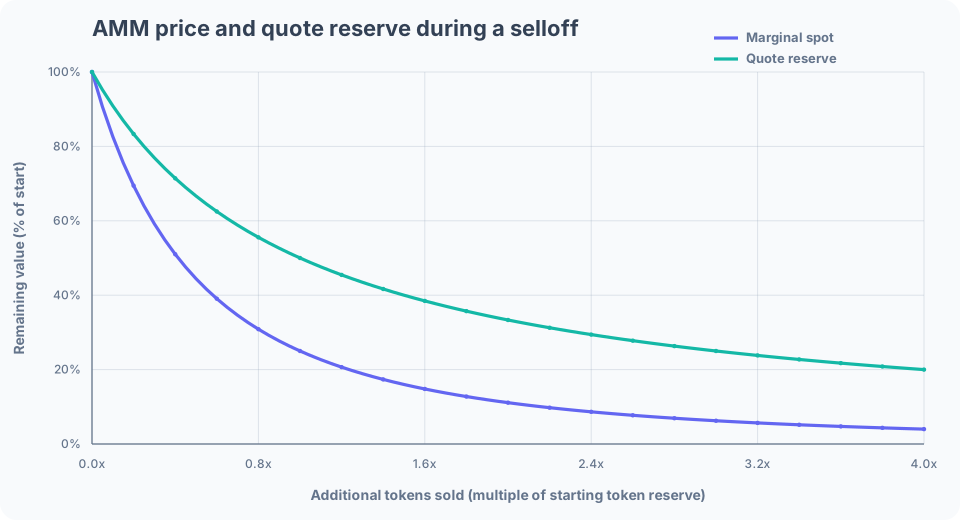 Locking the LP position keeps the pool available. Every holder still exits at the pool price remaining when their order executes.
## Market cap and exit value answer different questions
`spot × supply` marks every token at the latest marginal price. A small buy can therefore create a large reported market cap without placing the same amount of USDC in the pool.
Exit value depends on the full path through available liquidity. A large holder receives the average price across that path; the pre-trade marginal price describes only the next small unit.
## Why new tokens are hard to borrow against
An outside lender needs a dependable way to value and dispose of collateral. A thin token with only momentum-driven AMM liquidity can fall sharply during liquidation, so lenders respond with low capacity, high rates, or no market at all.
Holders who need cash are therefore pushed toward selling, which adds more downward price pressure.
## The SV3 structure
SV3 combines issuance, redemption, reserve custody, and floor-backed advances in one canonical market.
| Market feature | Typical launch curve / AMM | SV3 |
| ---------------- | ---------------------------------------------- | ----------------------------------------- |
| New supply | Inventory is distributed or traded from a pool | Canonical buys mint against reserve |
| Sells | Tokens enter a pool | Canonical curve sells burn |
| Quote backing | Shared pool reserves | Isolated reserve for one market |
| Downside path | Marginal price can approach zero | Curve flattens at the current gross floor |
| Fees | Revenue for platform, creator, or LPs | Revenue plus a fixed floor-backing share |
| Holder liquidity | Sell or find an external lender | Sell, floor redeem, or draw an advance |
| Market lifecycle | May migrate or graduate | One canonical market remains active |
This structure gives the market a higher-quality exit boundary while preserving speculative upside. Demand still determines the premium above floor, and that premium can disappear completely.
For the concrete mechanics, read [How SV3 Works](/how-it-works) or watch the [$10 launch and 400-trader simulation](/simulations/ten-dollar-launch).
Locking the LP position keeps the pool available. Every holder still exits at the pool price remaining when their order executes.
## Market cap and exit value answer different questions
`spot × supply` marks every token at the latest marginal price. A small buy can therefore create a large reported market cap without placing the same amount of USDC in the pool.
Exit value depends on the full path through available liquidity. A large holder receives the average price across that path; the pre-trade marginal price describes only the next small unit.
## Why new tokens are hard to borrow against
An outside lender needs a dependable way to value and dispose of collateral. A thin token with only momentum-driven AMM liquidity can fall sharply during liquidation, so lenders respond with low capacity, high rates, or no market at all.
Holders who need cash are therefore pushed toward selling, which adds more downward price pressure.
## The SV3 structure
SV3 combines issuance, redemption, reserve custody, and floor-backed advances in one canonical market.
| Market feature | Typical launch curve / AMM | SV3 |
| ---------------- | ---------------------------------------------- | ----------------------------------------- |
| New supply | Inventory is distributed or traded from a pool | Canonical buys mint against reserve |
| Sells | Tokens enter a pool | Canonical curve sells burn |
| Quote backing | Shared pool reserves | Isolated reserve for one market |
| Downside path | Marginal price can approach zero | Curve flattens at the current gross floor |
| Fees | Revenue for platform, creator, or LPs | Revenue plus a fixed floor-backing share |
| Holder liquidity | Sell or find an external lender | Sell, floor redeem, or draw an advance |
| Market lifecycle | May migrate or graduate | One canonical market remains active |
This structure gives the market a higher-quality exit boundary while preserving speculative upside. Demand still determines the premium above floor, and that premium can disappear completely.
For the concrete mechanics, read [How SV3 Works](/how-it-works) or watch the [$10 launch and 400-trader simulation](/simulations/ten-dollar-launch).